|

Intaglio printmaker Dan Steeves in the Mount Allison University Fine Arts studio.
|
Steeves' work has been exhibited in galleries in Canada, the United States, Holland, Italy, Japan, Poland, Taiwan and the Ukraine. His prints are represented internationally in both public and private collections.
He is represented by the Abbozzo Gallery of Oakville, Ontario, and the Peter Buckland Gallery of Saint John, New Brunswick.
Steeves is Printmaking Technician/Lecturer in the Fine Arts Department at Mount Allison University, and was born in Riverview, New Brunswick. He received his BFA from Mount Allison in 1981. |
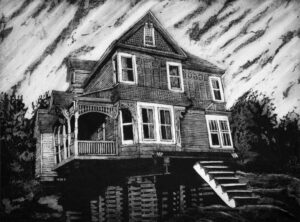
IN THE PASSAGE of our lives there is a sense of being in a state of naissance, a process of birth, never being quite mature. So it is that the house symbolizes the shelter and sanctuary in this maturing process.
DAN STEEVES’ work begins with the domicile but is transformed from the simple to the monumental.
|
|
|
 |
"People build homes, after all, to keep the outside out. Houses are stories, lies perhaps, that we tell ourselves about our safety, about our ability to determine our own fate, about 'us' and 'them'."
—Andrew Steeves, Gaspereau Press
|
|
|
 |
"Darling, let's build a house, We'll build it of stone and love, We'll make it stronger than a fortress, but warm enough for the coldest winter"
Micah Vierling, from his ballad "Build a House"
|
|
|
 |
Why do we return to the shore? Maybe it's because in a world like ours where so much changes-political and economic realities, our jobs, and our families, even our bodies-the shore will still be there.
—Mark Harris, from the letterpress bookwork "The Light That Lives in Darkness"
The Light That Lives In Darkness is also available in limited edition letterpress book form.
|
|
|
 |
"Everything" wrote the French philosopher Gaston Bachelaard,"Comes alive when contradictions accumulate." The prints of Dan Steeves have long been fecund places where paradox and contradiction abound.
Gil McElroy, from his essay "Things We Put on a Hill"
|
|
|
 |
A fundamental of the impulse to myth-making is the belief in the primacy of human creation to give form to the chaos of nature.
Tom Smart, from his essay "The Bone Fields"
|
|
|
 |
Many of Steeves' people and objects exist more as abstractions than as effusive esthetic clones, thus resisting a simply visceral reading.
Dennis Gill, from his essay "Sight Unseen"
|
|